
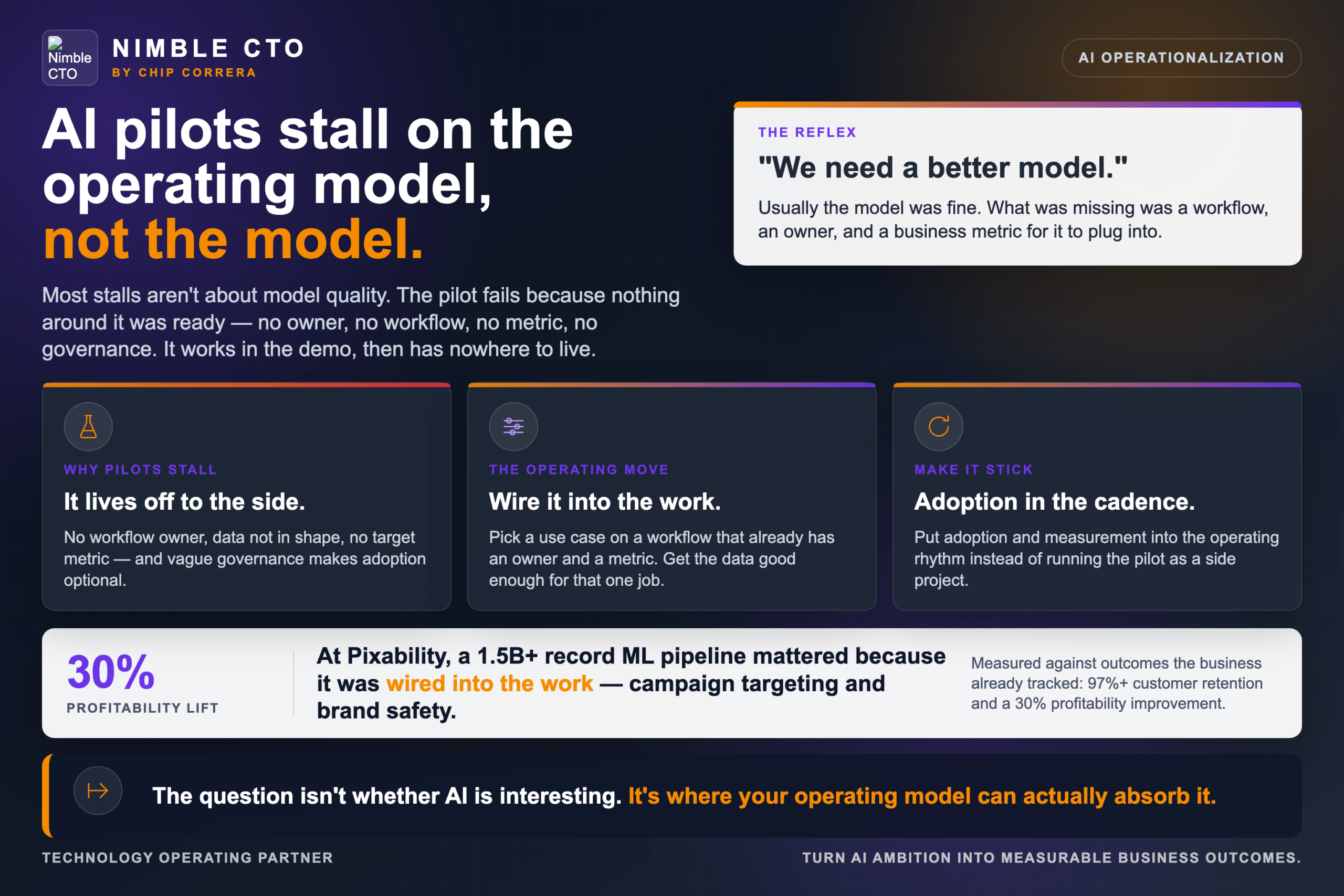
Most AI pilots that stall don’t stall because the model was wrong.
They stall because nothing around the model was ready.
The pattern is consistent: the use case isn’t attached to a workflow anyone owns. The data isn’t in shape. No one agreed up front which business number it was supposed to move. Governance is vague, so adoption is optional.
The technology works in the demo — and then has nowhere to live.
AI creates advantage through execution, not novelty. So the operating move is unglamorous: pick a use case tied to a workflow that already has an owner and a metric, get the data good enough for that one job, and put adoption and measurement into the operating cadence — instead of running the pilot as a side project.
Here’s what that looks like when it works.
At Pixability, we built an ML-driven YouTube data pipeline with more than 1.5 billion annotated records. But the part that mattered wasn’t the size of the pipeline. It was that the model lived within how campaigns were actually targeted and kept brand-safe — and it was measured against outcomes the business already cared about: 97%+ customer retention and a 30% improvement in profitability.
The AI wasn’t a demo off to the side. It was wired into the work.
Contrast that with the pilot that stalls: an impressive churn-prediction model that never gets connected to the renewal motion, so it predicts churn nobody acts on. Same quality of model. Completely different outcome.
The difference is rarely model quality. It’s whether the operating model can absorb it: data in shape, a clear owner, a real workflow, a business metric, and governance that makes adoption the default.
The question isn’t whether AI is interesting.
It’s where your operating model can actually absorb it.
No responses yet